
We provide commercial demolition in Prince William County for business owners, landlords, and property managers: interior strip-outs, white box build-backs, and small building teardowns. You get a clean, permitted shell ready for build-out on the date your lease requires.
This page answers one question. Should this space be stripped out, and what does the process and the schedule look like if it is?
Nothing gets built in a commercial space until the drop ceiling, the partitions, the dead plumbing, and the stacked layers of flooring are gone. That gap is where a strip-out lives, and it usually decides whether an opening date holds.
What does commercial demolition in Prince William County cover?
Commercial demolition in Prince William County covers everything from a single tenant suite stripped to the shell up to a small freestanding building taken to the slab. The scopes that come up most often:
- Interior strip-outs of retail, office, medical, and restaurant space
- White box build-back so a landlord can market a clean shell
- Tenant improvement demo between leases
- Restaurant equipment, hood, and walk-in cooler removal
- Warehouse racking, mezzanine, and shelving teardown
- Selective structural demolition for openings and expansions
- Small commercial building teardowns and outbuilding removal
- Parking lot, sidewalk, curb, and pad demolition
- Site clearing ahead of a new build
The common thread is that this work runs on somebody else's schedule. A landlord, a lender, a franchise opening date, or a tenant paying rent on space they cannot use yet.
What usually triggers commercial demolition or a strip-out?
A commercial strip-out is usually triggered by a change in who occupies the space rather than by a building problem. These are the events that put demolition on the calendar for Prince William County property owners:
- A lease turning over and the next tenant needing a different layout
- A property changing hands and the buyer resetting the space
- Long vacancy that has left a dated, unrentable interior
- Water damage, fire damage, or a failed roof
- Code or accessibility upgrades that mean opening walls anyway
- Redevelopment of an older commercial parcel into something denser
Redevelopment drives a lot of the volume in this county. The Route 1 corridor running through Woodbridge and down past Dumfries has been redeveloping steadily for years.
That means older single-story retail, motels, and service buildings coming down for mixed use, and it means a steady stream of interior strip-outs in the centers that stay.
Why do commercial interiors wear out faster than houses?
Commercial interiors wear out faster than houses because they carry more traffic, get modified more often, and sit empty between tenants. The causes behind most commercial demolition work in this county are straightforward once you know what to look for.
- Layered build-outs: each tenant added walls, soffits, and flooring over the last tenant's work instead of removing it, so a 1990s suite can hide three ceilings and four floors
- Water intrusion: flat roofs, roof-mounted HVAC units, and old parapet flashing leak into ceilings and wall cavities, and the damage spreads sideways before anyone sees a stain
- Vacancy: an empty unit loses heat, cooling, and dehumidification, which is when mold, frozen pipes, and swollen substrates appear
- Heavy use: restaurant grease, medical plumbing, and retail foot traffic destroy finishes on a much shorter cycle than residential wear
- Freeze and thaw outside: parking lots, curbs, and sidewalks crack and spall through Virginia winters, so pad and paving demolition often rides along with an interior job
- Dead systems: abandoned wiring, ductwork, and plumbing from prior tenants stays in the walls and gets in the way of every new layout
Should you renovate around the build-out or strip it to the shell?
Strip a commercial space to the shell when the existing layout fights the new use, and renovate around it when the bones of the build-out still fit. Getting that call right saves more money than any other decision on a Prince William County tenant project.
Strip it out when:
- The new tenant needs a materially different floor plan, since partial demo plus patching usually costs more than a clean strip and a fresh build
- Walls have to open anyway for new plumbing, electrical, data, or accessibility upgrades
- Flooring is stacked several layers deep, because levelling over layers rarely holds
- The space has sat vacant long enough that the finishes are dated, damaged, or both
- The landlord is marketing the unit and wants it to show as a white box
Renovate around what is there when:
- The next use is close to the last one, such as one office tenant replacing another
- Demising walls, restrooms, and the main mechanical layout are code-compliant and correctly placed
- The schedule is short and a cosmetic refresh gets the doors open on time
Ask the estimator to price both. On a mid-sized suite the gap between a selective demo and a full strip-out is often smaller than the cost of the patching and blending a partial job leaves behind.
What permits and inspections does commercial demolition require here?
Commercial demolition in Prince William County is held to a stricter standard than a house, and the federal asbestos rules are the biggest reason why. Those rules apply even to buildings where no asbestos is found.
The federal NESHAP rule requires a thorough asbestos inspection of a commercial facility before any demolition or covered renovation, and it requires written notification before the work starts even when the inspection finds no asbestos at all.
That notification period is measured in working days, so it has to be built into the schedule rather than discovered halfway through. In Virginia, the air program behind that notification is administered by Virginia DEQ.
Building and demolition permits for unincorporated Prince William County come from Prince William County Development Services, and properties inside the City of Manassas or the City of Manassas Park go through their own city offices instead.
Utilities have to be disconnected and confirmed at the source before a structure comes down, and in occupied buildings that means isolating only your unit while power, water, gas, sprinkler, and fire alarm keep serving everyone else.
That coordination with building management and the fire marshal is often the longest lead item on the whole job. Start it the week you sign, not the week before demolition.
What drives commercial demolition pricing in Northern Virginia?
Square footage sets the baseline for commercial demolition in Northern Virginia, and everything after that is about conditions. In this region conditions usually mean access and working hours.
- Total square footage and ceiling height
- Build-out density, since a medical suite has far more walls per foot than an open showroom
- Structural elements, slabs, and mezzanines in the scope
- Asbestos, lead, or other regulated material findings
- Loading dock access, or the lack of it, in older strip centers
- After-hours or phased work around occupied neighbors
- Debris tonnage, recycling requirements, and distance to disposal
Typical ranges for planning purposes in this market:
- Standard interior strip-out: roughly $3 to $9 per square foot
- White box build-back demo: roughly $5 to $12 per square foot
- Small freestanding commercial teardown: roughly $6 to $18 per square foot of footprint
- Parking lot and pad removal: priced by tonnage and haul distance
Regulated material is the one variable that can double a commercial demolition budget, because abatement is separate licensed work and it stops everything else until it is finished. Disposal is the steadier cost.
Loads run to the county complex at Independent Hill or to private construction and demolition facilities around Northern Virginia, priced by the ton, with clean concrete and metal diverted to recyclers when it is worth separating.
What does commercial demolition look like on site?
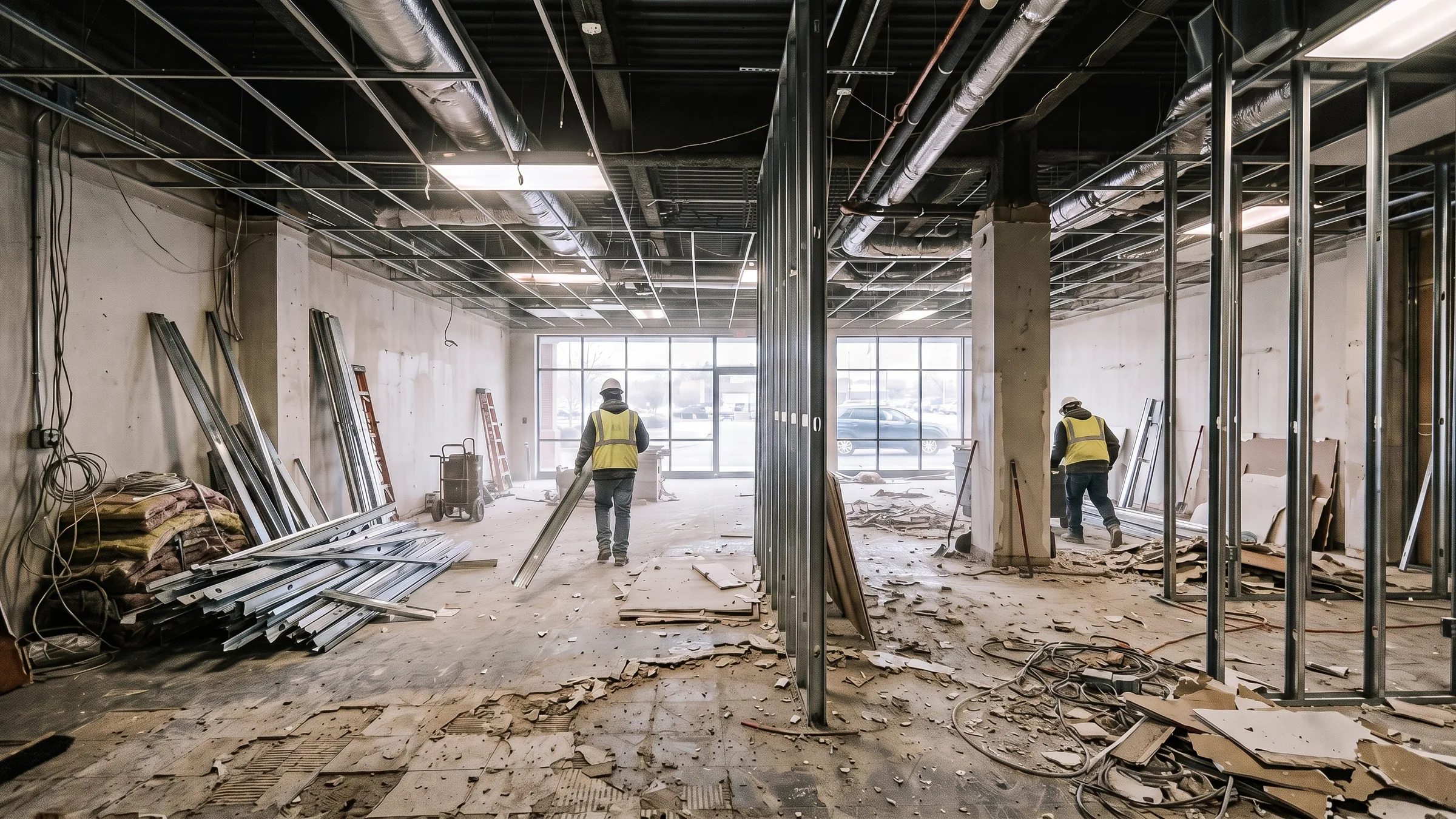
A commercial strip-out starts with protection and isolation rather than demolition: floor and elevator protection, dust walls at the demising line, HVAC returns sealed, and sprinkler and alarm devices addressed with the fire marshal's requirements in mind.
Strip-out then runs top down. Ceiling grid and mechanical first, then finishes, then partitions, then flooring and adhesive down to the slab. Material gets sorted as it comes out so metal and clean concrete are not paying landfill rates.
Daily cleanup is part of the job on any occupied property. Shared corridors, parking areas, and entrances get left usable every night, and the final handoff is a swept shell with capped utilities and documentation for the file.
Related services for commercial owners and tenants
Residential-scale gut-outs follow different rules and different pricing, so if the property is a house or a small rental unit, look at selective interior demolition instead.
When a commercial parcel is being reset from the ground up, the first phase is usually clearing and site prep, followed by paving and pad breakout. Owners in Manassas should plan for city permitting rather than county permitting on the same scope of work.
Commercial demolition questions from owners and property managers
Can you work nights and weekends so the other tenants stay open?
Yes. Off-hours work is standard on occupied retail and office properties in Prince William County. It costs more per hour than daytime work, but it is usually cheaper than the alternative, which is neighboring tenants losing business or a landlord refusing the schedule outright. Ask for both a daytime and an off-hours number so you can see what the schedule is actually buying you.
How much notice do you need before a strip-out starts?
Two to four weeks is realistic for a permitted commercial strip-out. The asbestos survey, the required notification period, and the building management approvals set that pace far more than crew availability does. If your lease has a hard turnover date, work backward from it and start the survey first, because the notification clock cannot be compressed once it begins.
Do you handle the asbestos survey, or does the owner?
The property owner is responsible for the asbestos survey, though it can be arranged as part of the project so results land before the schedule is set. Abatement itself is separate licensed work and has to finish before regulated material is disturbed. Getting the survey done early is the cheapest schedule insurance on any commercial demolition, because a late finding stops every other trade on the job.
Can you provide recycling and disposal documentation?
Yes. Weight tickets and diversion records are available for every load leaving the site. That documentation matters when a project is chasing a green building credit, when a landlord requires proof of proper disposal, or when a lender wants a paper trail. Ask for it in the contract rather than after the trucks are gone, since tickets are easy to collect during the job and hard to reconstruct later.
What is a white box, exactly?
A white box is a finished empty shell: clean demising walls, a level slab, capped utilities, and usually a basic ceiling and lighting grid. It is the condition a landlord hands to a new tenant so that tenant can build out without paying to undo the last one. Delivering white box costs more than a bare strip-out, but it shortens vacancy because the space shows well and a new tenant can start immediately.
Do you take out equipment, racking, and fixtures?
Yes. Restaurant hoods and line equipment, walk-in coolers, warehouse racking, shelving, and fixtures all come out as part of a commercial strip-out scope. Salvageable equipment can be set aside for resale instead of scrapped, which sometimes offsets part of the demolition cost. Say so before mobilization, because once equipment is cut apart for removal its resale value is gone.
Get your space on schedule
Commercial demolition schedules are won or lost in the first two weeks. Send the square footage, the address, and your target turnover date, and you will get a scope, a price range, and a realistic timeline that accounts for the survey and notification windows.
Call now, or use the form below and you will get next steps in writing.