
We provide pool removal in Prince William County for homeowners who are done with an in-ground or above-ground pool: draining, shell breakout, compacted fill, grading, and the county permit. The result is usable yard again, with lower upkeep and less liability to carry.
This page answers one question. Should you fill in the pool, and what does that job actually involve?
Filling in a pool has more moving parts than it looks. How the shell is handled and how the hole is filled decide whether that ground stays solid for the next thirty years, and whether you can ever build on it.
Partial removal or full removal, and why the choice matters
Every in-ground pool removal in Prince William County starts with a choice between partial and full removal, and that choice changes both the price and what you can do with the space afterward. Nothing else on the job matters as much.
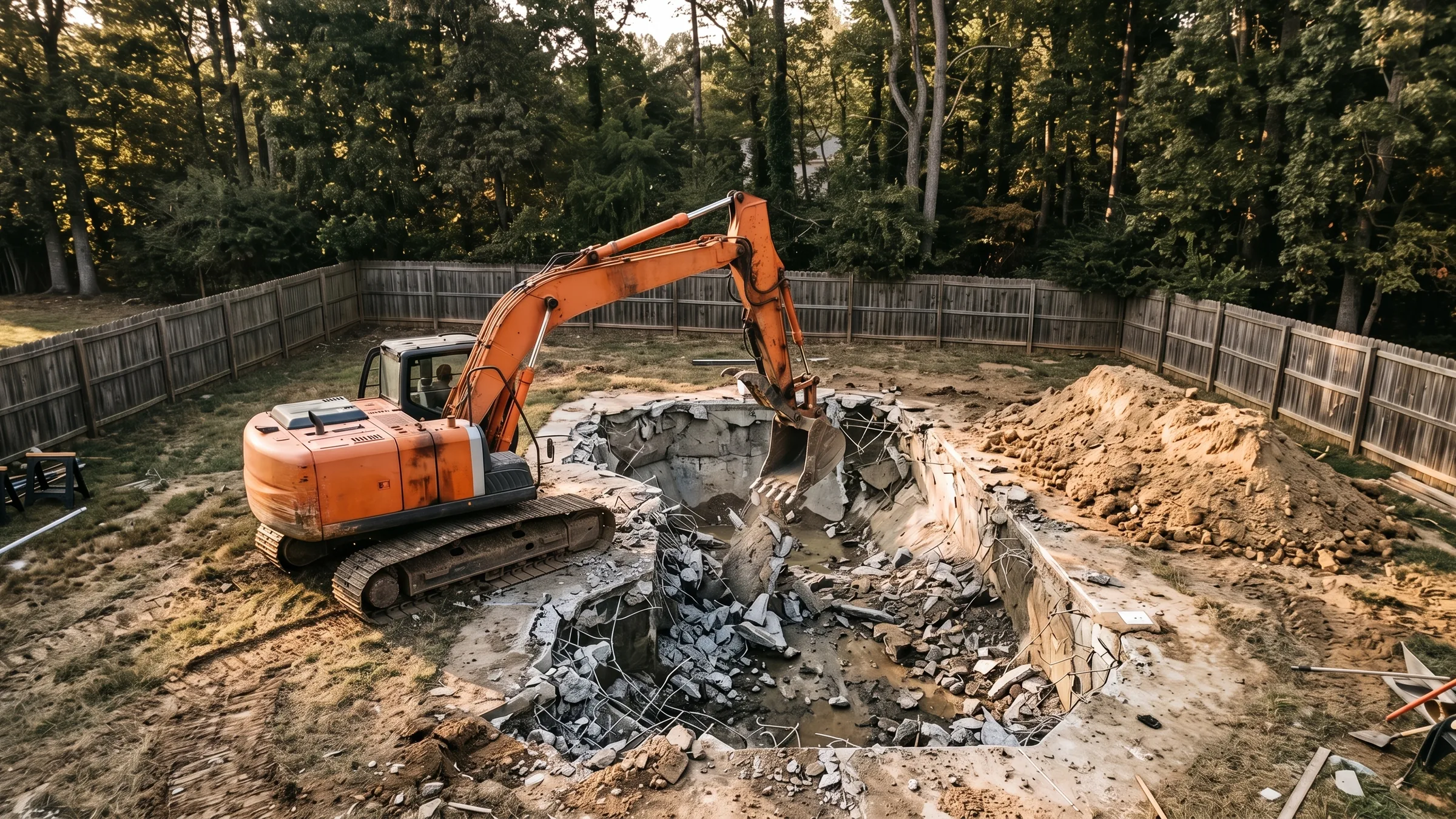
Partial removal means the top two to three feet of wall come off, holes get cut through the bottom of the shell so water drains through, the broken concrete is buried in place, and clean fill goes back in compacted lifts.
Partial is the faster and cheaper option, and it works well when the area is going back to lawn or a simple planting bed. It typically costs about half what full removal costs.
Full removal means the entire shell, walls, floor, plumbing, and steel all come out of the ground and off your property, and the hole is filled with engineered fill and compacted to a spec.
Only a full removal leaves ground that can normally support a future addition, garage, or slab, and only a full removal avoids permanent limits on what you build over that footprint.
When does pool removal make more sense than another repair?
Removing the pool makes more sense than repairing it once the repair quote approaches what a few more years of use is worth to you. For a pool nobody swims in, that line arrives quickly, and most Prince William County owners cross it at the same handful of moments.
- The liner, plaster, or coping is due and the repair quote is thousands
- The pump, heater, and filter are all near end of life at the same time
- Nobody in the house swims anymore and the kids are gone
- Your homeowners policy costs more, or the carrier is asking questions
- The fence, gate, and alarm requirements are a constant headache
- You want the yard for a shed, a garden, a patio, or simply grass
- You are selling, and the pool is shrinking your buyer pool instead of growing it
Keep the pool and repair it instead when:
- The shell and the deck are sound and only the liner or the pump is due
- The pool gets real use through the summer and the upkeep is not a burden
- You are in a neighborhood where a working pool genuinely adds resale value
The math is different for an unused pool than for a used one. Between chemicals, power, water, opening and closing, and the insurance line, a neglected in-ground pool can quietly cost four figures a year to own.
Why do in-ground pools reach the end of their life?
In-ground pools reach the end of their life because the shell, the steel, and the equipment all age on similar clocks, and Virginia weather pushes all three. These are the failures behind most pool removal calls in this county.
- Freeze and thaw: water gets into hairline cracks in the shell or the deck, freezes each winter, and widens the crack a little more every season
- Steel corrosion: rebar and wall panels rust once water reaches them, and rusting steel expands, which cracks the concrete around it from the inside
- Groundwater pressure: water in the soil pushes against an empty or low shell, which is why a pool should never simply be drained and left sitting
- Base and soil movement: the clay soils common here swell and shrink with moisture, shifting decking and coping out of level
- Equipment age: pumps, heaters, and filters installed together tend to fail within a few years of each other
- Liner and plaster wear: surfaces are consumable and reach the end of a normal service life on a predictable schedule
Age explains why this comes up so often in older county neighborhoods. Plenty of the in-ground pools in the established parts of Dale City went in during the 1970s and 1980s with the original house.
That puts them well past the point where a liner swap and a new pump make financial sense, especially for owners who stopped swimming years ago.
What permits does pool removal require in Prince William County?
Filling in an in-ground pool is demolition, so it requires a permit from Prince William County Development Services before any work starts, and it closes out with an inspection.
Skipping that step is how people end up with an unpermitted fill on record, which surfaces later during a sale or a building application and costs far more to resolve than the permit would have cost.
You can find the county's permitting information through Prince William County Development Services. Electrical and gas service to the pool equipment has to be disconnected and capped before demolition, the same rule that applies to any structure teardown.
Water and sewer accounts tied to a pool house, if you have one, get handled with the service authority before the building comes down.
Draining is regulated too. Chlorinated pool water should not be pushed straight into a storm drain or a stream. It gets held or treated until chlorine levels drop and then released slowly where it can soak in, or discharged to the sanitary sewer with permission.
Virginia DEQ oversees the state water program behind those rules, and the Occoquan watershed that drains much of eastern Prince William County is watched more closely than most.
What does in-ground pool removal cost in Northern Virginia?
In-ground pool removal in Northern Virginia is priced on pool size, construction type, how much fill the hole needs, and above all whether a machine can reach the backyard. Typical ranges in this region:
- Partial removal and fill of a standard residential pool: roughly $6,000 to $14,000
- Full removal with everything hauled off: roughly $12,000 to $25,000
- Above-ground pool removal: roughly $500 to $3,000
- Surrounding concrete decking, if it goes too: often $1,500 to $5,000 on top
Access is usually worth more to your final price than pool size, because a gate narrower than a mini excavator turns a two-day job into a week of hand work and wheelbarrows.
Fenced yards backing to steep grade near the reservoir, common through the Lake Ridge area, are the classic example. Measure your gate opening before you call and you will get a far more accurate range.
Fill is the other cost people forget. A 16 by 32 foot pool holds a great deal of empty space, and clean fill has to be trucked in by the load.
Where the dirt comes from and how far it travels shows up directly on the invoice, just like where the broken concrete goes: the county complex at Independent Hill, a private construction and demolition facility, or an aggregate recycler for the clean material. To compare pool removal against other demolition work, see the Prince William County demolition cost guide.
What happens during a pool removal, day by day?
A pool removal runs in four stages: drain, demolish, fill, and close out the permit. Water comes out first, at a controlled rate, over a day or more, and then the equipment pad is cleared and the electrical and gas lines are confirmed dead at the source.
Machines break the deck and the shell next. On a partial removal, the upper walls come off, the floor gets punched through for drainage, and the rubble is broken small enough to compact. On a full removal, every piece is loaded and trucked out.
Fill goes back in lifts of roughly a foot, each one compacted before the next, rather than dumped in one pile that will settle for years. The last few inches are topsoil, graded to drain away from your house and your neighbors, and seeded if that is in the scope.
Then the county inspection closes the permit. Keep that paperwork. It is the document that answers every future question about what is under the lawn.
Related work that comes with a pool removal
Most pool projects come with a concrete deck, coping, and a walkway that need breaking out and hauling away, and sometimes an old pool house or cabana that is really a small outbuilding teardown.
We do the same work for homeowners in neighborhoods across Woodbridge and on the larger lots south toward Dumfries and the Quantico corridor.
One more trade often follows this one. The pool-code fence around the old pool no longer has a job once the hole is filled, so many owners remove or replace fencing as the last step of the project. That is fence contractor work rather than demolition work, and it belongs to that trade's side of a yard rebuild.
Common questions about filling in a pool
How long does it take to remove an in-ground pool?
Two to five days of on-site work for most residential pools in Prince William County, once the permit is issued and the water is out. Draining alone can take a day or more because it has to happen at a controlled rate. Full removal runs longer than partial removal because every piece of the shell leaves the property instead of being crushed and buried in place. Add two to four weeks up front for permitting.
Will the ground sink later where the pool used to be?
Not if the fill is placed correctly, and that comes down to method rather than luck. Proper fill means mechanical compaction in lifts of about a foot instead of one dumped pile, plus drainage holes cut through the bottom of the shell on a partial removal so water never collects underneath. Ask any contractor how they compact and how they drain before you compare prices. A cheap fill that settles for a decade is the most expensive version of this job.
Can I build a shed, patio, or addition over a filled pool?
Over a full removal, generally yes, subject to permits and a soils review. Over a partial removal, usually no, because the buried shell and the fill above it are not engineered to carry a footing. That is the main practical reason to pay for full removal if you have any plans for a shed, patio, garage, or addition on that part of the yard. Decide before the work starts, because reversing a partial fill later costs more than doing it right once.
Do I have to tell a buyer the pool was filled in?
Yes. A filled-in pool is a material fact in a Virginia home sale, so keep the permit, the inspection sign-off, and the fill records together in one folder. Buyers, appraisers, and home inspectors all ask about the flat spot in the yard. Having the paperwork turns an awkward negotiation into a short answer, which is the strongest practical reason to permit the fill properly in the first place.
What happens to the pool water?
It gets drained at a controlled rate rather than pushed into a storm drain. Chlorinated water has to sit or be treated until the chlorine level drops before it can be released to the ground, and discharge to the sanitary sewer needs the service authority to approve it first. That matters more in Prince William County than in most places, because much of the county drains toward the Occoquan Reservoir, a drinking water source.
Do you remove above-ground pools too?
Yes, and an above-ground pool is far simpler than an in-ground fill-in. The liner, wall, and framing come apart and haul away, then the sand base and any pad underneath get graded out. Most above-ground removals are a single-day job and cost a small fraction of an in-ground project. If a concrete pad or a surrounding deck is going too, that gets priced as its own line item.
Get your yard back this season
Filling in a pool pays you back in yard space, lower upkeep, and one less system to keep alive. Tell us the pool size, the gate width, and whether you want partial or full removal, and you will get both prices so you can pick with real numbers in front of you.
Call today, or send the details below and you will get a plan and a range back.